Skip to content
Here’s a scenario that plays out every day in commercial construction.
An architect sits down to write a project specification. They open an office master, pull up the relevant specification section for a scope of work, and start editing. The specified product will make it into the bidding stage and likely be the one that gets purchased.
The manufacturer whose 3-part specification they trust, whose language is borrowed, whose features are used is often the product that wins the project. The product that hasn’t been specified will now be required to chase what’s been specified and prove that it meets what’s been specified.
That’s the game. And for building product manufacturers, the 3-part specification is how you play it.
What is a 3-Part Specification?
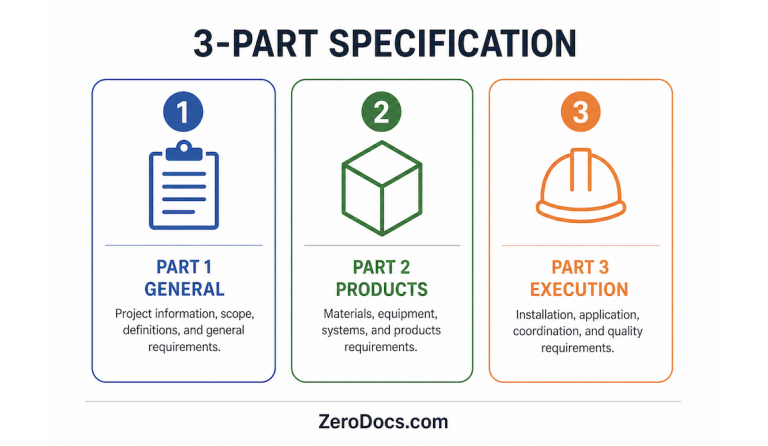
A 3-part specification sometimes called a guide spec or manufacturer’s guide specification is the document architects use to specify your product into a construction project. It’s organized into three sections:
- Part 1 – General covers scope, applicable standards, submittal requirements, and quality assurance. This is where architects learn what you expect from them administratively and what certifications or qualifications apply.
- Part 2 – Products describes the product itself: materials, components, performance requirements, finishes, and which manufacturers are acceptable. This is where your competitive position lives.
- Part 3 – Execution covers installation, surface preparation, application or erection procedures, tolerances, and field quality control. This section is what contractors actually read on the job.
When a guide spec is done right, architects pull it into their project documents and edit it minimally. Your product, your standards, and your language go into the construction documents. When it’s done wrong, they toss it and use a competitor’s instead.
So Who Should Write Yours
There’s no shortage of opinions on this inside a manufacturing company. Here’s an honest look at each option.
Your Marketing Team
Marketing is good at a lot of things. Technical specification writing isn’t one of them. Not because they aren’t capable people, but because guide specs require a completely different skill set than product content.
A spec written by marketing tends to read like a brochure that learned to count to three. The structure might be there, but the language gives it away. Specifiers have seen thousands of these documents. They know immediately when something is selling to them instead of serving them, and they move on.
The job of a guide spec isn’t to promote your product. It’s to make an architect’s job easier. Those are not the same assignment.
Your Engineering Team
This one is closer. Engineers know the product, they speak the language of standards and performance criteria, and they don’t pad Part 2 with marketing copy. A spec written by engineering is usually technically accurate.
The problem is that technical accuracy is table stakes, not the finish line. Engineers write for precision. Specifiers need precision plus a document that fits cleanly into their workflow, uses the language they’re accustomed to, and positions your product competitively without creating specification problems downstream.
That gap. Between technically correct and specification-ready. Is where projects get lost.
A General Technical Writer
Bringing in outside writing help is a reasonable instinct. A good technical writer will produce a clean, well-organized document. But construction 3-part specification writing is a specialty within a specialty. The formatting conventions, the standard references, the submittal language, the way acceptable manufacturer clauses need to be structured. These come from years of working inside the construction industry, not from general technical writing experience.
You can bridge this gap by pairing a technical writer with an in-house subject matter expert. But at that point you’ve got two people doing a job that one experienced specification writer handles alone.
A Specification Writing Service That Knows Construction
This is the option that produces a document architects actually use.
An experienced specification writing service brings the full picture: industry-standard document structure, working knowledge of standards and other applicable standards, and, critically, a real understanding of how specifiers work. They know what Part 1 needs to say to make submittals manageable. They know how to write Part 2 so your product is protected competitively without triggering a sole-source objection. They know what Part 3 has to cover so installers don’t call an RFI on day one.
That knowledge doesn’t come from a style guide. It comes from time spent on the specifier’s side of the table.
What Separates a Good Guide Spec from a Useless One
A few things that experienced specifiers look for and that separate documents that get adopted from ones that get deleted:
It’s concise. Specifiers are not reading your guide spec for pleasure. They’re working. A bloated document that buries the relevant information in 10+ pages of boilerplate signals that the writer didn’t understand the audience.
The standards are right. An incorrect or outdated standard reference isn’t a minor error. It tells a specifier that the document hasn’t been maintained, which raises questions about everything else in it.
It doesn’t sound like an ad. Phrases like “superior quality” and “unmatched performance” don’t belong in a specification. They belong on a trade show banner. A specifier who reads marketing language in a guide spec will rewrite the whole thing or skip it.
The format is familiar. Architects work from templates. If your document doesn’t match the structure they’re used to, it creates friction. Friction means rewrites. Rewrites mean your language doesn’t make it into the project.
The Real Cost of a Bad Guide Spec
A weak guide spec isn’t just a document problem. It’s a sales problem.
Every project where your spec doesn’t get adopted is a project where your competitor’s did. Every architect who tries to use your guide spec and gives up is an architect who won’t reach for it again. Every over-specified installation instruction in Part 3 is a potential change order, RFI, or liability issue that traces back to your document.
The spec is a sales tool. It just doesn’t look like one.
What ZeroDocs Does
ZeroDocs writes 3-part guide specifications for building product manufacturers. Our team brings more than 30 years of hands-on experience in construction specifications. Including time spent on the architect and specifier side. And we build documents that get used, not filed away.
If your product is headed into commercial construction and you don’t have a guide spec architects can actually work with, call us. That’s exactly what we do.
Architects: Browse the Templates
ZeroDocs.com writes guide specifications for building product manufacturers. We help you get into the specification and stay there.