Skip to content
Picture this. An architect is sitting at her desk at 4:30 pm on a Thursday. You’ve got two submittals due before end of day, a contractor who won’t stop calling, and a guide specification section you still need to pull into a project. You download the manufacturer’s 3-part specification.
It’s 22 pages.
What’s the odds that you close it and search for a competitor’s 4-page version instead?
That’s not a hypothetical. That’s Thursday.
Why a Long Guide Specification Works Against You
Most building product manufacturers assume the opposite. They figure a thorough, detailed document signals expertise. It shows the architect they’ve done their homework. It proves the product is serious.
It doesn’t.
What a 20-page guide specification actually signals is that the person who wrote it wasn’t thinking about the architect. They were thinking about themselves. Their product, their features, their thoroughness. A specifier reading your document isn’t evaluating your company. She’s trying to finish her job. Your document is a tool. If it’s hard to use, she’ll reach for a different tool.
How Long Should a Guide Specification Be?
Three pages. Maybe four. Enough to cover the product accurately and give the architect a clean, usable starting point. Nothing more.
This surprises most people in the building products world. But the architects and specifiers who use these documents every day will tell you the same thing: a tight, well-written guide specification gets adopted. A bloated one gets skipped.
There Are Two Documents — Most Building Product Reps Only Think About One
Here’s the part most building product reps miss entirely.
There are two completely different documents in the world of specifications. The first is the guide specification. What you write to get your product specified in the first place. The second is the project specification. What an architect produces when she actually puts your product into a set of construction documents.
Those are not the same job. Not even close.
At the getting-specified stage, your only goal is to make it easy for an architect to say yes. You want her to open your guide specification, understand what the product is, trust that it’s been written correctly, and drop it into her document with minimal editing. That’s the whole mission.
You are not writing project documentation at this stage. The architect does that. Your job is to give her a clean, usable starting point. Not a finished specification she didn’t ask for.
When manufacturers load a guide spec with project-level detail, excessive qualifications, and paragraphs of boilerplate that belong in construction documents, they’re solving the wrong problem at the wrong time. The architect isn’t going to thank you for doing her job. She’s going to skip your document and use the one that respects her time.
Your Guide Specification Is Your Sales Rep on Paper
Building product reps are relationship people. They sell face to face, over lunch, on a job site walk. That’s where trust gets built.
But the guide specification is doing its own selling at 4:30pm on a Thursday. When you’re not there, when the architect just needs to get the section done and go home. That document is your rep in the room when you can’t be.
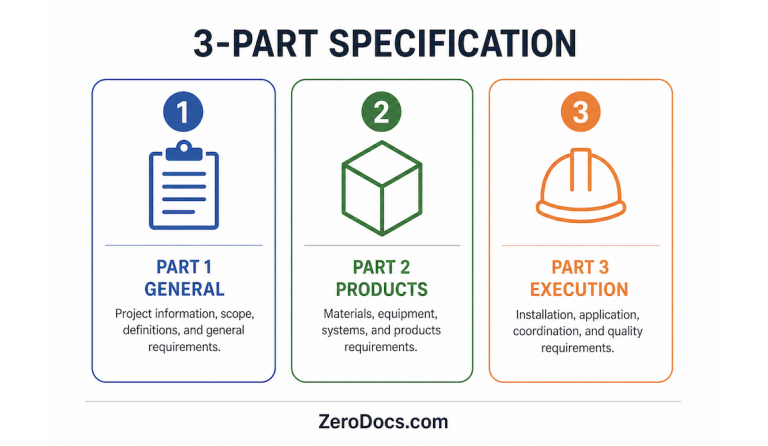
A well-written guide specification covers three things cleanly. Part 1 tells the architect what she needs to know administratively —> scope, references, submittals, and quality requirements. Part 2 describes the product itself —> materials, performance criteria, finishes, and who makes it. Part 3 tells the installer what to do —> preparation, application, and field requirements.
If a sentence doesn’t serve one of those three jobs, it doesn’t belong in the document. Three pages of tight, accurate, usable content will get your product specified more often than twenty pages of everything you know about it.
Make it easy to use. Make it easy to adopt. Make it easy to trust.
Short wins.
Frequently Asked Questions
How long should a guide specification be?
For most building products, three to four pages is the right length. Enough to cover Part 1 administrative requirements, Part 2 product description, and Part 3 installation, without padding.
What is the difference between a guide specification and a project specification?
A guide specification is written by the manufacturer to help architects specify their product. A project specification is written by the architect for a specific construction project. They serve different purposes at different stages and manufacturers who confuse the two end up writing documents architects can’t use.
Why do architects prefer shorter guide specifications?
Architects work under deadline pressure across multiple projects simultaneously. A concise, accurate guide specification reduces the editing work on their end and gets adopted faster. A long, complex document creates friction and friction means your product gets passed over.
ZeroDocs writes guide specifications for building product manufacturers. If your current spec is working against you, we can fix that.