 Skip to content
Most building product manufacturers spend years developing a product worth specifying. Then they hand the specification off to marketing.
That’s where things get a little fuzzy.
Marketing takes a stab at writing your specification, or they enlist the help of a sales rep that’s got experience in bidding projects. Between the two, they create a specification that is 10+ pages, too promotional, or written in a language that specifiers don’t trust. One of the common pitfalls you often see from manufacturers is trying to save money and check the box of having a specification.
This is a fixable problem. But first you have to understand what a specification actually is and what it isn’t.
What a 3-Part Specification Actually Does for Your Product
A 3-part specification for building product manufacturers is a sales tool for architects is called a guide spec or manufacturer’s guide specification. It guides the architect on how to specify your product and offers notes or comments for the specifier to follow to create a project specification using your product.
It is not a brochure. Not a product data sheet. And definally not a sell sheet with three headings.
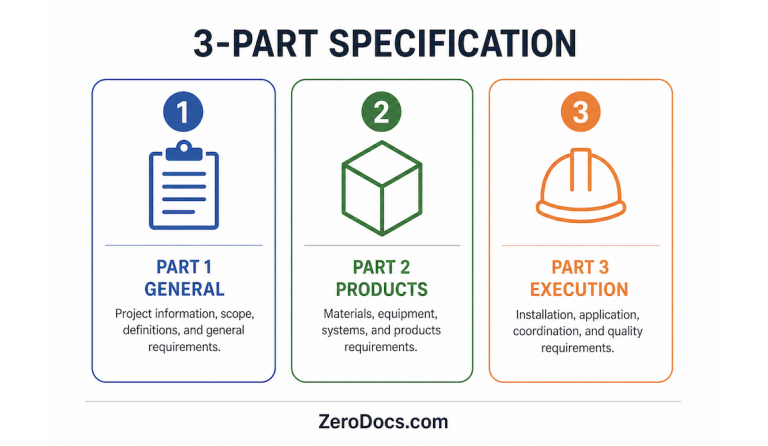
It is a technical document organized into three distinct parts: Part 1 General, the Part 2 Products, and finally Part 3 Execution. Each part serves a specific function in the construction process. PART 1 covers scope, submittals, and administrative requirements. Then PART 2 describes the product itself, materials, performance criteria, and acceptable manufacturers. And finally, Part 3 covers installation, field conditions, and quality control.
When written correctly, an architect can easily have that aah moment of how to specify the product, how to edit the spec minimally, and move the product into a project. Your language is in the contract documents. And your product’s performance standards are what the contractor will see as a product requirement.
That’s what a good guide spec does. It does the selling before anyone ever makes a phone call.
Why Most Manufacturer Guide Specs Don’t Get Used
Architects review hundreds of guide specs a year. They know immediately, within the first page, whether a spec was written by a specifier who writes guide specifications or if the building product manufacturer took a stab at doing it on their own.
A spec written for them by a specifier is concise, technically accurate, and formatted the way they expect. It fits cleanly into their workflow. It doesn’t create trust factor problems.
A spec written by someone taking a stab at it reads like a brochure or a technical data sheet. It’s padded with marketing language.
- Part 1 overlooks administrative requirements.
- Part 2 is a product catalog in disguise.
- Part 3 goes on like an installation or warranty manual.
Architects don’t edit those specs. They discard them and use a competitor’s instead.
The most common reasons a manufacturer’s guide spec doesn’t get used:
It’s too long. Specifiers are under time pressure on every project. A 10+ page guide spec for a single product signals that the author doesn’t understand how specs get used in the real world.
It reads like marketing copy. Superlatives, brand language, tons of copyright and trademark symbols, and promotional phrasing have no place in a specification. The moment an architect sees them, trust is gone.
It’s technically incomplete. Missing performance criteria, vague submittal requirements, and absent installation guidance force the specifier to do work that should have been done before the spec was handed to them.
It’s not formatted correctly. Industry standard formatting exists for a reason. A spec that ignores it creates confusion and extra work…. two things no specifier will tolerate.
Any one of these problems is enough to get your spec rejected. Most manufacturer specs have all four.
What ZeroDocs Delivers
ZeroDocs writes 3-part specifications for building product manufacturers who are serious about getting specified and staying specified.
We’re not a software platform. We don’t write specs using AI. We’re experienced specifiers who have spent time on both sides of the desk, the manufacturer side and the architect side. That combination is not common. It changes everything about how a spec gets written.
Every guide spec we deliver is:
Written in the language architects and specifiers expect. Not marketing language. Not engineering language. Specification language is precise, neutral, and formatted for use.
Sized correctly for the product. A guide spec should be as long as it needs to be and not one page longer. We write specifications that get used, not sections that get filed or minimized as a google chrome page tab.
Technically complete. Part 1 covers what it needs to cover. The Part 2 describes your product accurately, competitively, and without giving the substitution game away. And Part 3 gives installers what they need to do the job right.
Easy to follow. Ready to drop into a project manual. That’s the standard we write to. Not “good enough to send.” Good enough to use.
Our specification writing services cover everything building product manufacturers need: new guide specs written from scratch, existing specs updated to current standards, proper section formatting and numbering, submittal requirements, sustainability documentation, and Environmental Product Declarations for manufacturers whose clients require third-party environmental data.
Who We Write Specs For
We write specifications for building product manufacturers across dozens of product categories: roofing, flooring, doors and frames, fenestration, wall systems, specialty products, and more.
If your product is sold into commercial construction and you don’t have a guide spec architects can work with, we write it.
Current spec is outdated, too long, or written by someone who has never sat across from a specifier, we fix it.
Never had a specification program and don’t know where to start, we build it with you.
The manufacturers we work with aren’t all the same size. Regional brands. Start-ups launching a new product line that need specs before the sales team hits the road. National brands with a specification library that was built piecemeal by whoever happened to know the product best at the time.
What they have in common is this: they understand that the spec is not a formality. It is a sales tool. The most durable, highest-leverage sales tool in commercial construction and the one most manufacturers still treat as an afterthought.
Ready to Get Specified?
If your product is headed into commercial construction, the question isn’t whether you need a guide spec. You do. The question is whether the one you have or the one you’re about to send is good enough to get used.
Most aren’t.
Browse our free specification downloads to see what a professionally written guide spec looks like. Or go straight to the services page and let’s talk about your product.
Frequently Asked Questions (FAQ)
A 3-part specification also called a guide spec or manufacturer’s guide specification is the document architects use to specify a building product into a construction project. It’s organized into three parts: Part 1 General covers scope, submittals, and administrative requirements. Part 2 Products describes the product itself — materials, components, performance criteria, and acceptable manufacturers. Part 3 Execution covers installation methods, field conditions, and quality control. When written correctly, an architect can pull a 3-part spec directly into their project manual with minimal editing. Your product, your standards, and your language go into the construction documents before a contractor ever bids the project.
A guide spec is a document written by or for a manufacturer that an architect can edit for use on a specific project. It’s written to be edited. A proprietary spec is a specification written by an architect that names a specific product and manufacturer as the only acceptable option. Getting your guide spec in front of the right architects before the project starts is how you earn a proprietary spec. One leads to the other. Most manufacturers focus on the sale. The ones who win consistently focus on the spec first.
A professionally written guide spec typically takes two to four weeks from kickoff to final delivery, depending on the complexity of the product and how much technical documentation the manufacturer can provide upfront. The process involves a product review, an estimate confirming scope, specification writing, and a revision round with the manufacturer’s technical team. Rushing a guide spec to hit a project deadline is one of the most common and costly mistakes manufacturers make. A spec submitted before it’s ready does more damage than no spec at all.
Specification writing cost varies based on the complexity of the project, the number of specifications sections required, and the current state of any existing documentation. ZeroDocs works with manufacturers of all sizes. From single-product brands launching their first guide spec to established manufacturers updating an entire specification library. The better question isn’t what it costs. It’s what a single specified project is worth to your company and how many of those you’re losing right now because your guide spec isn’t good enough to be used. Get in touch, and we’ll give you a straight answer on scope and investment.
Yes. Updating an existing guide spec is one of the most common engagements we take on. Manufacturer specs go stale fast. Products change, standards update, and the spec that was written five years ago by someone who has since left the company often has problems nobody noticed until an architect flagged them on a project. We review your existing spec, identify what needs to change, and deliver an updated version that’s formatted correctly, technically current, and ready to use. In many cases, a spec update is faster and less expensive than starting from scratch and the result is the same.
