 Skip to content
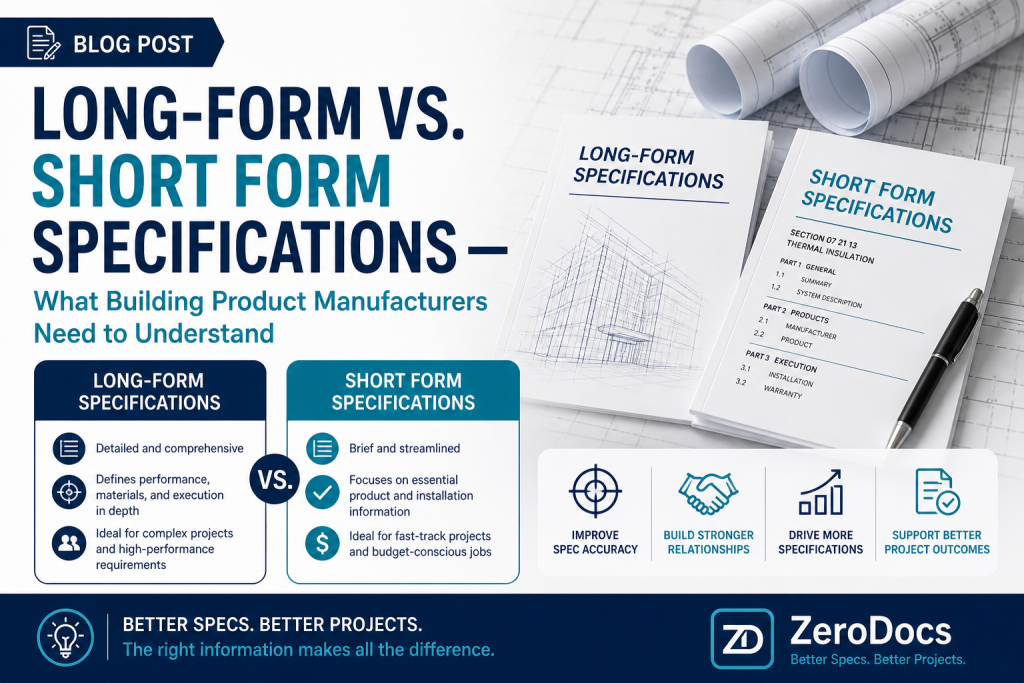
Long-Form vs. Short Form Building Products
Long-Form vs. Short Form Specifications — What Building Product Manufacturers Need to Know
A long-form specification and a short form specification follow the same 3-part structure — General, Products, Execution, but differ in depth, length, and the project scale they were written for.
That distinction determines whether your guide specification gets pulled into a project manual or passed over for a competitor whose document was easier to work with.
Before we go further, one thing needs to be said clearly.
You are not writing a project specification.
You are writing a guide specification. A document designed to make it easy for an architect to specify your product. Those are two completely different jobs with two completely different standards for what success looks like.
A project specification is written by an architect for a specific construction project. It is comprehensive by necessity. It governs project requirements, what gets used, and what standards the contractor is held to.
A guide specification is written by a manufacturer for an architect’s use. Its only job is to make your product easy to specify and understand what’s important to specify with the least friction possible.
More pages does not mean more thorough.
More pages does not mean more complex.
More pages means more work for the architect and more risk that your guide spec gets closed without being used.
The right length for your guide specification depends on one thing: the complexity of your product and the scale of the projects it serves. A simple interior product sold into tenant improvement work needs a clean two-page section. A complex building envelope system sold into large commercial construction may 5 pages or more.
Neither is more professional than the other.
Neither signals more about your product’s quality than the other.
The only question that matters is whether the architect on the other end of that document can use it on the project sitting on their desk right now.
More on short form specifications. Long-form vs short form specification building products wont matter if its overlooked.
The Difference Between Long-Form and Short Form Specifications
The difference between a long-form specification and a short form specification is not structure.
Both follow the same 3-part format — General, Products, Execution. Are complete construction documents. Both are legally enforceable. Examples.
The difference is depth, length, and the scale of project they were written for.
For building product manufacturers, that distinction determines whether your guide specification gets pulled into a project manual or passed over for a competitor whose document was easier to work with.
What Is a Long-Form Specification?
A long-form specification covers every aspect of a specified scope in exhaustive technical detail. Where a short-form section runs 1 to 5 pages, a long-form section runs 10 or more pages. Where a short form gives an architect exactly what they need to specify your product correctly, a long form gives them everything, including requirements that may never apply to the project at hand.
A long-form specification typically includes:
Extensive quality assurance requirements and pre-installation conference obligations. Multiple acceptable manufacturers with detailed comparison and substitution criteria. References to dozens of industry standards — ASTM, ANSI, and others — by number and year. Detailed mock-up, sample, and field test requirements. Comprehensive inspection, testing, and commissioning language. Extended warranty terms and closeout documentation requirements.
On a hospital, a federal building, a university campus, or any large publicly bid project — this level of documentation is appropriate and often contractually required. The project scale, liability exposure, and contractor accountability requirements justify it.
For manufacturers whose products are sold primarily into large commercial, institutional, or publicly bid construction — a long-form guide specification is the right document. It signals that your product is built for that level of scrutiny and that your company can support the documentation requirements that come with it.
What Is a Short Form Specification?
A short form specification covers the same three parts — General, Products, Execution — at a depth appropriate for the project scale. It gives an architect exactly what they need to specify your product correctly. Nothing more.
A well-written short form specification section runs one to five pages. It includes:
The product specified and the performance standard it must meet. The submittals required before work begins. The requirements a contractor will be held to. The quality control and materail requirements that apply.
Short form specifications are the right document for residential products, tenant improvement scopes, small commercial applications, renovations, and design-build delivery. They are complete. They are enforceable. And critically; they are the specifications architects actually use when they are under time pressure on a project.
Which is most projects.
Why Most Manufacturer Guide Specs Are the Wrong Length
Here is the problem most building product manufacturers don’t see coming. A manufacturer writes a guide specification or has one written, and defaults to long-form commercial language because it looks more professional. Fifteen pages. Dozens of referenced standards. Submittal requirements written for a federal project.
Then they send it to an architect working on a tenant improvement who has forty-five minutes to finish the specification section before the deadline.
The architect opens it. Sees twenty pages. Closes it.
And specifies a competitor’s product because their guide spec was four pages and ready to use in the time available.
A guide specification that is too long for the projects your product typically serves is not a comprehensive document. It is a barrier to being specified. A contractor overwhelmed by a twenty-page specification section does what contractors always do when they’re overwhelmed. They skim it. They miss things. And when something goes wrong — you discover that a specification nobody read is a specification that didn’t exist.
The Industry Bias Toward Longer Is Wrong
The construction industry has a habit of treating long-form specifications as the professional standard regardless of project scale.
They are not.
A twenty-five page guide specification for a building product sold primarily into small commercial and residential construction is not more professional than a clean four-page section covering the same ground.
It is just longer.
The experienced specifier knows this. The architect under deadline pressure knows this. Manufacturers who watch their guide spec get ignored during the specification process on project after project is starting to figure it out.
Length is not a proxy for quality. A specification that is accurate, is the most effective sales and specification tool you can have.
How to Choose the Right Specification Length for Your Product
Your product needs a long-form guide specification when it is sold primarily into large commercial, institutional, federal, or publicly bid construction. When the projects it serves have dedicated specifiers, extensive submittal review processes, and high contractor accountability requirements. When the complexity of your product warrants exhaustive technical documentation.
Your product needs a short form guide specification when it is sold into residential, small commercial, tenant improvement, renovation, or design-build markets. When the architects specifying it are working without dedicated specifiers on staff. When your product needs to be easy to pull into a project manual quickly — because that is the reality of how specifications get written on most projects.
Match the specification to the projects your product actually serves. Not the projects you wish it served. The projects where your sales team is actually winning work.
What Happens When the Wrong Specification Reaches the Wrong Architect
The short form specification is not a shortcut. It is not a lesser document. It is the right tool for the majority of commercial construction projects that get built every year.
When a short form guide specification lands on an architect’s desk at the right moment — complete, clean, correctly structured, and sized for the project they are working on — it gets used. Your language goes into the contract documents. Your standards are what the contractor is required to meet.
That is what a guide specification is supposed to do.
Match the document to the project your product serves.
Not the other way around.
How ZeroDocs Writes Guide Specifications That Get Used
ZeroDocs writes 3-part guide specifications for building product manufacturers. The difference between a short form and a long form often comes down to who’s going to use the specification on a project.
We have spent years on both sides of this desk. Know what an architect under deadline pressure will use and what they will skip. The difference between a specification written to impress and one written to get specified.
Every guide specification we deliver is written to be pulled directly into a project manual with minimal editing. That is the standard we write to, not to impress building product manufacturer’s, good enough for an architect to use.
If your current guide specification is too long, too technical, or written for the wrong type of project — that is exactly what we fix.
Get in touch. We’ll tell you what your product needs and what it takes to get there.
Frequently Asked Questions
A long-form specification and a short form specification follow the same 3-part structure — General, Products, Execution — but differ in depth, length, and the project scale they were written for. A long-form section runs ten to thirty pages and is written for large commercial, institutional, or publicly bid construction. A short form section runs one to five pages and is written for residential, small commercial, tenant improvement, and design-build projects. Both are complete, legally enforceable construction documents. The difference is how much detail is appropriate for the project at hand.
A manufacturer guide specification is a 3-part specification document written by or for a building product manufacturer that architects use to specify that product into a construction project. It follows the General, Products, Execution structure and is designed to be pulled directly into an architect’s project manual with minimal editing. A well-written guide specification is one of the most effective sales tools a building product manufacturer can have, because it does the selling before anyone picks up the phone.
It depends on the projects your product is sold into. If your product serves large commercial, institutional, federal, or publicly bid construction with dedicated specifiers and extensive submittal review processes — a long-form guide specification is appropriate. If your product serves residential, small commercial, tenant improvement, renovation, or design-build markets where architects are working under time pressure without dedicated specifiers — a short form guide specification will get used far more consistently. The right answer is always determined by the scale of the projects your product actually serves.
Architects working on small to mid-size projects are under significant time pressure. When a guide specification runs thirty pages for a scope that a four-page section would cover completely, the architect has two choices — spend hours editing it down or move to a competitor whose document is ready to use. Most choose the latter. A guide specification that creates more work than it saves is a barrier to being specified, not a sales tool.
A guide specification writing service writes 3-part specification documents for building product manufacturers. The process typically involves a product review, a drafting phase, and a revision round with the manufacturer’s technical team. A qualified guide specification writing service understands both what manufacturers need their products to say and what architects need a specification to do. Those are two different things. Most manufacturer-written guide specs get it wrong because they’re written from only one perspective.
A guide specification should be exactly as long as it needs to be for the projects your product serves — and no longer. For most building products sold into residential, small commercial, and tenant improvement markets, one to five pages covers everything an architect needs to specify the product correctly. For products sold into large commercial, institutional, or publicly bid construction, ten to thirty pages may be warranted. Length is not a proxy for quality. A specification your architect can use in the time they have available is worth more than a comprehensive one that gets closed without being read.
Guide specification writing cost varies based on the complexity of the product, the number of sections required, and the current state of any existing documentation.
Some services charge up to $8,000 for a specification.
The more relevant question is what a single specified project is worth to your company, and how many you are losing because your current guide specification is the wrong length, the wrong format, or written from the wrong perspective. Get in touch with ZeroDocs and we will give you a straight answer on scope and investment.
